In the article, Identity, Authority, and Learning to Write
in New Workplaces, Elizabeth Wardle introduces the concept of tools when it
comes to discourse communities. She does a study on a new employee who just graduated college named Alan. Alan see's himself above everyone else, and what Wardle does is kind of negative. She says that Alan is a tool and that some members are persceived not as a member but as a tool as she states. Alan is in a different discourse community and doesn't think he needs to change his ways for this discourse community.
Wednesday, October 31, 2012
Wardle

Sunday, October 28, 2012
Reading Response #16
Summary:
In the article "Materiality and Genre in the Study of Discourse Communities," DeVitt, Bawarshi, and Reiff attempt to show how genre is related to discourse communities, and they argue that by learning genres one can fully learn how to understand a discourse community.
Synthesis: A couple articles that relate to this article would be Gee and Swales because they deal with discourse communities. But Gee and Swales state there definitions of what a discourse community is, and DeVitt, Bawarshi, and Reiff define it by genre.
Personal Response: I thought this article was very informational and I learned something from it. It helped learn more about what genre is in a discourse community because I didn't know what it was exactly. It wasn't as bad as some of the other readings we have done.
In the article "Materiality and Genre in the Study of Discourse Communities," DeVitt, Bawarshi, and Reiff attempt to show how genre is related to discourse communities, and they argue that by learning genres one can fully learn how to understand a discourse community.
Synthesis: A couple articles that relate to this article would be Gee and Swales because they deal with discourse communities. But Gee and Swales state there definitions of what a discourse community is, and DeVitt, Bawarshi, and Reiff define it by genre.
Personal Response: I thought this article was very informational and I learned something from it. It helped learn more about what genre is in a discourse community because I didn't know what it was exactly. It wasn't as bad as some of the other readings we have done.
Project 3 Proposal
For the discourse community I chose to do for Project 3 is my
sorority, Alpha Gamma Delta. I just rushed a couple a weeks ago so I am a new
proud member of this sorority. The main goals of my sorority we support
lifelong learning as a means to gain understanding and wisdom, we promote the
value of fraternal membership and commitment to higher education, we help
prepare members to contribute to the world's work, and we advocate lifetime
involvement in Alpha Gamma Delta. The mechanisms of intercommunication among
our sorority are that we have chapter every Sunday at 6. Right now since I am a
new member we have a new members meeting to learn all the goals and everything
about the alpha gamma fraternity. At chapter we discuss what all we have to do
in our chapter like sisterhoods, philanthropy, and anything else our president
says we have to do. We also have Rho Mom’s that are like Big Sisters’ to us.
They are girls who are going to help you if you have questions, and to be a
future great friend.
In participatory
mechanism primarily to provide information and feedback to our sorority, the
main big thing we use to get information out to everyone is by e-mail. We have
a facebook page and we text each other to let us know information. We pay money
to be in our sorority, and we do philanthropy to help out people with diabetes.
We do different types of socials, sisterhoods, and fundraisers throughout the
year. We have alumni’s that come back every year for homecoming, and we give
them a tour of the house. New members always join in fall when we have formal
or sometimes informal rush.
My interest in my sorority is to gain life-long friendships,
sisterhoods, and networking. I am currently becoming part of a sorority that is
all about sisterhood, and personal development through that sisterhood. What I am
interested in is finding out what Alpha Gamma Delta mean, and what different
types of sisterhoods we do. When I interview someone I will interview a
freshman/ new pledger, and existing member. I have two girls I have in mind
that I want to interview and we have a sisterhood coming up to meet all the
older girls. The text I will analyze are going to be our e-mails, and chapter
minutes. E-mails tell us information we need to know and what is going on.
Chapter minutes are sent to us in e-mail of what we discussed in the chapter
meeting. I am very interested in learning more about my sorority and what it is
all about and the language/writing it has in this discourse community.
Tuesday, October 23, 2012
Gee Response
Summary:
In his article "Literacy Discourse, and Linguistics: Introduction," James Paul Gee attempts to explain to the reader what a discourse is and what the different types of discourses are. He then argues that literacy is"the mastery of or fluent control over a secondary discourse."
Synthesis:
This article relates to the last article we read which was John Swales' "The Concept of Discourse Community" because in both of the articles they discuss what they believe is a discourse community and the differences between the two.
Before you read:
3 activities I am involved in are soccer, sorority, and schooling (college). None of my activities that I am involved in do not influence in the way I participate in. I join a sorority to gain friendship, to network, and get to know new people. They do remain distinctly separate in my life. Sororities do can help me with schooling. Soccer gives me time management, and get stuff done with school.
Questions for Discussion and Journaling:
1. What Gee means when he says you can speak with perfect grammar and yet be "wrong nonetheless" he is saying the way you speak is influenced by the social environment that you grew up in. No this doesn't conflict with what I've been caught in school because it doesn't have the biggest effect on me because what I've learned in high school has always stuck in me since school and learned my grammar.
Opinion:
I thought that this article was interesting. I liked how Gee broke up discourses into different types. I had never really thought about something like that before. I also was intrigued by the idea of the capital "D" and the lowercase "d" idea.
In his article "Literacy Discourse, and Linguistics: Introduction," James Paul Gee attempts to explain to the reader what a discourse is and what the different types of discourses are. He then argues that literacy is"the mastery of or fluent control over a secondary discourse."
Synthesis:
This article relates to the last article we read which was John Swales' "The Concept of Discourse Community" because in both of the articles they discuss what they believe is a discourse community and the differences between the two.
Before you read:
3 activities I am involved in are soccer, sorority, and schooling (college). None of my activities that I am involved in do not influence in the way I participate in. I join a sorority to gain friendship, to network, and get to know new people. They do remain distinctly separate in my life. Sororities do can help me with schooling. Soccer gives me time management, and get stuff done with school.
Questions for Discussion and Journaling:
1. What Gee means when he says you can speak with perfect grammar and yet be "wrong nonetheless" he is saying the way you speak is influenced by the social environment that you grew up in. No this doesn't conflict with what I've been caught in school because it doesn't have the biggest effect on me because what I've learned in high school has always stuck in me since school and learned my grammar.
Opinion:
I thought that this article was interesting. I liked how Gee broke up discourses into different types. I had never really thought about something like that before. I also was intrigued by the idea of the capital "D" and the lowercase "d" idea.
Sunday, October 21, 2012
Reading Response #14 Swales
Summary:
In his article "The Concept of Discourse Community," John Swales attempts to explain to the reader what a discourse community is and offer a set of criteria to make it more clear as well as how they work. He argues that a speech community has different criteria than a discourse community and it is important to know the difference between the two.
Before you Read:
A time when I felt out of place was when I was rushing for a sorority. I went to a house and it was the first day and we walked in and the girls did a fashion show. I felt so "out of place" because I don't like fashion that much, I just wear clothes that I like. I am not the girl-est girl but I can be girly but the fashion show at this house was ridiculous, and I just felt so uncomfortable being there.
Synthesis:
“The Concept of Discourse Community” shares similarities to “Intertextuality and the Discourse Community”, James Porter’s article because they are both showing text relationship. The reader has a clear view of the discourse community and it's different movements. Both deal with concept and how it is beneficial to writing.
Questions for Discussion and Journaling:
5. A discourse community that I belong to would be my soccer team. It meets the six characteristics of a discourse community because everyone on my team loves the sport and wants to work hard to get better at it. Everyone on the soccer team also gets updates and emails regarding times and the practice schedule. Our lexis would be that we always make up crazy nicknames for corner kicks or free kicks and nobody understands them or gets what we are trying to do. The genres of this were just the different types of drills that we would practice and deciding what the names of the plays would be.
Opinion:
I thought the article was interesting because it discussed the concept of discourse and discourse communities in various ways.The reading was very difficult for me but I feel like all the readings are difficult for me to read.
In his article "The Concept of Discourse Community," John Swales attempts to explain to the reader what a discourse community is and offer a set of criteria to make it more clear as well as how they work. He argues that a speech community has different criteria than a discourse community and it is important to know the difference between the two.
Before you Read:
A time when I felt out of place was when I was rushing for a sorority. I went to a house and it was the first day and we walked in and the girls did a fashion show. I felt so "out of place" because I don't like fashion that much, I just wear clothes that I like. I am not the girl-est girl but I can be girly but the fashion show at this house was ridiculous, and I just felt so uncomfortable being there.
Synthesis:
“The Concept of Discourse Community” shares similarities to “Intertextuality and the Discourse Community”, James Porter’s article because they are both showing text relationship. The reader has a clear view of the discourse community and it's different movements. Both deal with concept and how it is beneficial to writing.
Questions for Discussion and Journaling:
5. A discourse community that I belong to would be my soccer team. It meets the six characteristics of a discourse community because everyone on my team loves the sport and wants to work hard to get better at it. Everyone on the soccer team also gets updates and emails regarding times and the practice schedule. Our lexis would be that we always make up crazy nicknames for corner kicks or free kicks and nobody understands them or gets what we are trying to do. The genres of this were just the different types of drills that we would practice and deciding what the names of the plays would be.
Opinion:
I thought the article was interesting because it discussed the concept of discourse and discourse communities in various ways.The reading was very difficult for me but I feel like all the readings are difficult for me to read.
Sunday, October 7, 2012
Reading #13 Wysocki
Summary:
In her article "The Sticky Embrace of Beauty", Anne Frances Wysocki attempts to explain to the reader about the way that advertising is pleasing and/or offensive. She states how women are objectifying by showing how beauty is in advertisements, how they are going to stand out or pleasure someone, but in context it can sometimes be offensive to a women.
Syntheis:
I think this article relates to the Bernhardt article in the way that they both talk about the visual aspects of writing piece, and how they have different effects on the reader.
Pre-Reading:
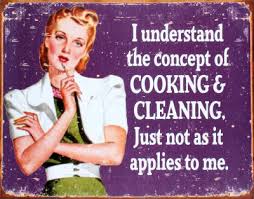 This is what every man thinks a woman should do, cook and clean. Of course this will make me mad. But i like this advertisment because it is funny how she is like " just not as it applies to me." It is old but it has a sense of humor but is so true. Men should and can clean and cook also not just woman.
QD:
2. The way Wysocki sets up her article is a little werid for me, she uses too many quotes so I got a little lost and confused on what she was trying to say. I would say it is a low visual but at time she had some visual elements because she explain the effects in detail.
3. The Peek ad for me as a consumer would work because it has a picture and has important details on it, personally I wouldn't buy it because I don't like but it makes me wonder how much stuff is out there in the world that puts out information like that.
AE:
2. I agree with Wysocki that “beauty is something we construct together” and subjected to social forces because everyone is has beauty but some people just don't construct it together in time to see that they have beauty. Everyone is beautiful in there own way.
Meta Moment:
To me the statement does apply to what Wysocki explains because she states that beauty catches the eye and that you have to go outside of the box at times, and if you don't then you will just be there forever. I don't know really how it applies to other visual art.
My thoughts:
I thought this reading was a little confusing with all the quotes and stuff she put in it, and it was a very long and boring. I guess I am just a boring reader but I didn't enjoy reading the article, and didn't really get what she was trying to state.
In her article "The Sticky Embrace of Beauty", Anne Frances Wysocki attempts to explain to the reader about the way that advertising is pleasing and/or offensive. She states how women are objectifying by showing how beauty is in advertisements, how they are going to stand out or pleasure someone, but in context it can sometimes be offensive to a women.
Syntheis:
I think this article relates to the Bernhardt article in the way that they both talk about the visual aspects of writing piece, and how they have different effects on the reader.
Pre-Reading:
QD:
2. The way Wysocki sets up her article is a little werid for me, she uses too many quotes so I got a little lost and confused on what she was trying to say. I would say it is a low visual but at time she had some visual elements because she explain the effects in detail.
3. The Peek ad for me as a consumer would work because it has a picture and has important details on it, personally I wouldn't buy it because I don't like but it makes me wonder how much stuff is out there in the world that puts out information like that.
AE:
2. I agree with Wysocki that “beauty is something we construct together” and subjected to social forces because everyone is has beauty but some people just don't construct it together in time to see that they have beauty. Everyone is beautiful in there own way.
Meta Moment:
To me the statement does apply to what Wysocki explains because she states that beauty catches the eye and that you have to go outside of the box at times, and if you don't then you will just be there forever. I don't know really how it applies to other visual art.
My thoughts:
I thought this reading was a little confusing with all the quotes and stuff she put in it, and it was a very long and boring. I guess I am just a boring reader but I didn't enjoy reading the article, and didn't really get what she was trying to state.
Thursday, October 4, 2012
Reading Response #12
Summary:
In his article, “From Pencils to Pixels: The Stages of Literacy Technologies,” Baron attempts show how limited research is at a point where technology and literacy collide. Baron states that literacy researchers have filed to understand writing as a technology. He argues that researchers haven't understood what we are actually doing when we write. He really brings up more questions about literacy and technology.
Synthesis:
This reading relates to the Malcolm X reading because it is very personal. I think it relates the topics to its theme and the audience really gets what he is trying to say.
Pre-Reading:
List of technologies I use for writing are: Computer, Iphone, Music, Verbal communication, and internet.
Questions for Discussion and Journaling:
2. Yes i agree that this seems to be one of his messages he brings up in his writing. Technology is always improving but sometimes to me I think some of things that are invented are sometimes pointless or need to be updated. The shape and nature of writing to me is always changing because of all of the new technology.
Thoughts:
I thought this reading was very long and got boring at times but for the most part made me think a lot more about technology. He really grasps the audience at times, and has very good topics to help his argument. Overall, it is a very good piece of writing.
In his article, “From Pencils to Pixels: The Stages of Literacy Technologies,” Baron attempts show how limited research is at a point where technology and literacy collide. Baron states that literacy researchers have filed to understand writing as a technology. He argues that researchers haven't understood what we are actually doing when we write. He really brings up more questions about literacy and technology.
Synthesis:
This reading relates to the Malcolm X reading because it is very personal. I think it relates the topics to its theme and the audience really gets what he is trying to say.
Pre-Reading:
List of technologies I use for writing are: Computer, Iphone, Music, Verbal communication, and internet.
Questions for Discussion and Journaling:
2. Yes i agree that this seems to be one of his messages he brings up in his writing. Technology is always improving but sometimes to me I think some of things that are invented are sometimes pointless or need to be updated. The shape and nature of writing to me is always changing because of all of the new technology.
Thoughts:
I thought this reading was very long and got boring at times but for the most part made me think a lot more about technology. He really grasps the audience at times, and has very good topics to help his argument. Overall, it is a very good piece of writing.
Subscribe to:
Comments (Atom)